
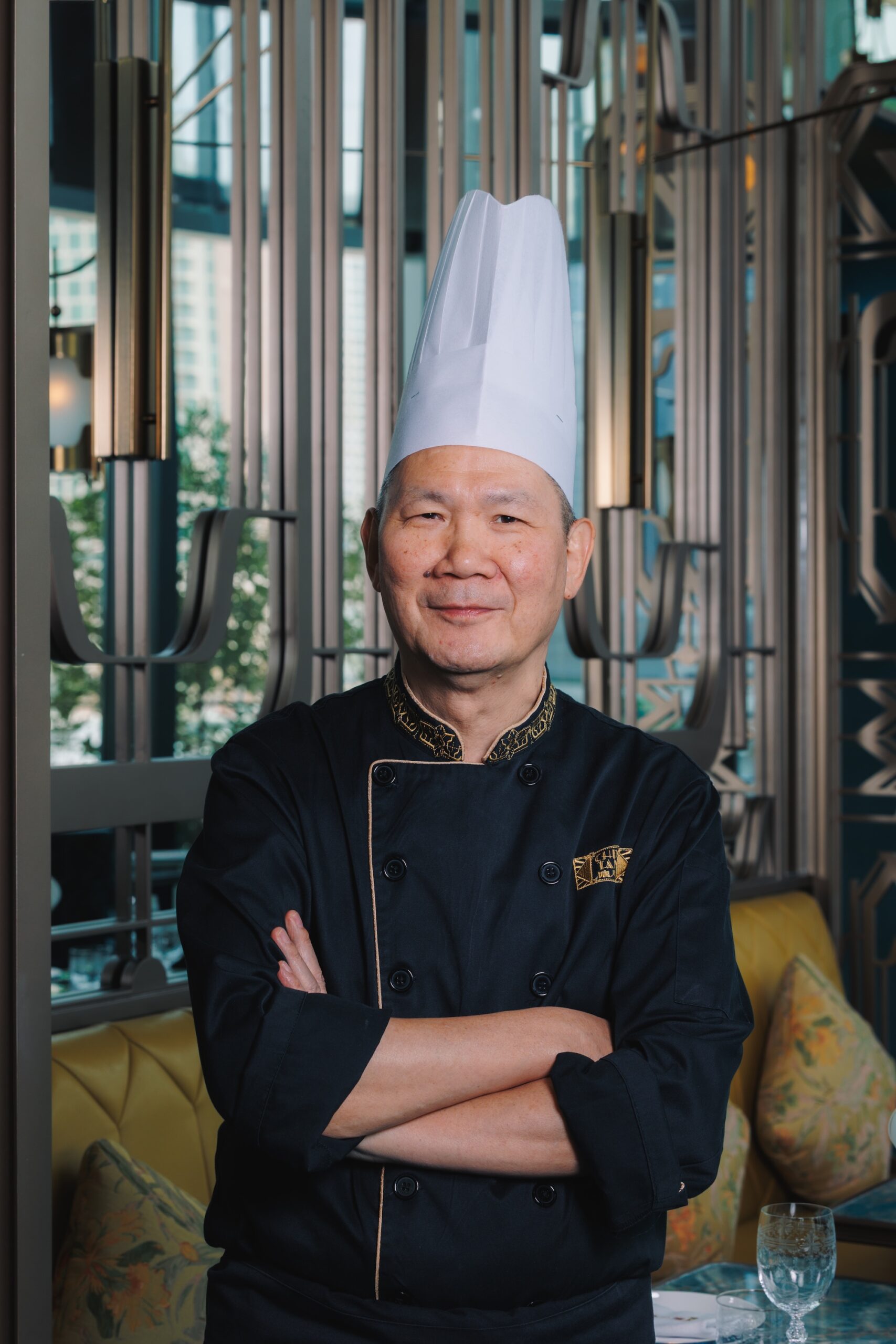

With over four decades of experience across some of Asia’s most respected kitchens, Chef Simon Wu brings deep-rooted expertise in Cantonese cuisine to China Tang Dubai. His career spans leading roles in Beijing, Seoul, and Tianjin, including time at Michelin-recognised and Michelin-starred establishments such as the Four Seasons Hotel Seoul (1 Michelin star) and Michelin-recommended venues like Kerry Hotel Beijing.
Can you take us through your professional journey and what brought you to Dubai?
My journey in hospitality has taken me across several dynamic cities over the past three decades. Originally from Hong Kong, I left in 1989 to pursue international opportunities, with much of my career spent in Beijing. Working across different cultural environments has always been a source of inspiration for me, as each city brings its own discipline, pace, and expectations.
Relocating to Dubai marked my first experience in the Middle East. It was a move driven by curiosity and respect for the city’s rapidly evolving hospitality scene and its international outlook. Since July 2025, I have been part of China Tang Dubai, my first restaurant venture in the region. It has been a rewarding opportunity to bring the spirit and elegance of China Tang to such a cosmopolitan destination.
What’s the hardest thing about running a fine dining Chinese kitchen that people outside the industry wouldn’t expect?
What is often underestimated is how many elements must align perfectly behind the scenes. Exceptional cuisine alone is never enough, true fine dining is the result of complete harmony across the entire operation.
It begins with the setting and atmosphere, which shape the guest’s first impression. This is supported by strong leadership from the restaurant manager, who must understand luxury hospitality at every level. In the kitchen, the head chef must balance technical mastery with discipline, consistency, and creativity.
Equally important is menu design, which must reflect both authenticity and guest expectation, while sourcing remains one of the most critical challenges. In refined Chinese cuisine, ingredient integrity is non-negotiable and maintaining consistency while working across local and international supply chains requires constant precision.
At China Tang Dubai, the challenge lies in ensuring all of these elements come together seamlessly, so the guest experiences effortless excellence.
Is there a dish that took you the longest to get right?
One dish that required significant refinement was our Singapore Chilli Prawn. We wanted to honour the depth of flavour found in the classic Singapore Chilli Crab while translating it into a more refined, elegant expression.
Finding the right balance of sweetness, acidity, spice, and richness took multiple rounds of adjustment. The goal was always clarity of flavour, vibrant, precise, and layered while staying true to the soul of the original dish.
How do you source your ingredients here in Dubai?
Sourcing in Dubai requires both structure and flexibility. We work with a combination of carefully selected local produce and premium imported ingredients to preserve authenticity and consistency.
Certain speciality items are sourced globally and imported with strict attention to handling and timing. This ensures that the integrity of the ingredients is never compromised from origin to kitchen.
Among these is Japanese Kumamoto Wagyu beef, graded BMS 8, selected for its exceptional marbling, tenderness, and depth of flavour. Every ingredient we use is chosen with precision, always in service of delivering a refined Cantonese dining experience.
You describe your approach as balancing authenticity with modern refinement. Where does that line sit for you practically? What would you never touch and what do you consider fair game to reimagine?
Authenticity is the foundation of everything we do at China Tang Dubai. The core techniques, flavour principles, and cultural heritage of Cantonese cuisine are never compromised.
Modern refinement, for us, is not about alteration for its own sake, but about elevation through presentation, ingredient quality, balance, and subtle adaptation to contemporary dining preferences.
What we would never change are the fundamental techniques and flavour structures that define Cantonese cuisine. What we can thoughtfully evolve is how those traditions are expressed, particularly in presentation or through bespoke dishes created for individual guest preferences. Ultimately, innovation must serve tradition, not replace it.
You’ve mentioned drawing inspiration from daily routines. Can you walk me through what a typical morning looks like before service?
No two services are ever the same, which makes preparation essential. My mornings are focused on ensuring complete readiness and consistency across every section of the kitchen.
Before service, we review and prepare all core elements – sauces, soups, dim sum, BBQ items, desserts, and batters, ensuring each meets our standards. Everything is tasted and checked to confirm consistency.
We then hold a detailed team briefing covering daily specials, live seafood, promoted dishes, and any changes to availability. This ensures the entire team is aligned before service begins and can respond confidently to guest needs.
How do you keep a team motivated when the standard is already high and the expectation is just to maintain it?
Consistency is only the baseline. True motivation comes from continuous improvement. We maintain clarity in standards across every detail, so the team understands exactly what excellence looks like, not just what is acceptable. This removes ambiguity and builds discipline.
We also work closely with trusted suppliers to ensure consistency in quality, which gives the kitchen confidence in execution. Beyond that, we continuously evolve the menu based on guest feedback and dining patterns, so the team is always engaged in refining and improving the experience.
Dubai’s dining scene has matured considerably. As someone working in the fine dining space, what do you think the city still gets wrong about Chinese food?
Dubai has made significant progress in understanding Chinese cuisine, but there is still a tendency to view it as a single category rather than a collection of distinct regional traditions. In reality, Chinese cuisine is deeply diverse, with Cantonese cuisine representing just one of many refined culinary philosophies.
Many restaurants understandably adapt their offerings to suit broad guest preferences, which leads to a blended interpretation. At China Tang Dubai, our focus is to present a more defined Cantonese identity, one rooted in technique, balance, and respect for tradition.
What’s the one thing you’d change about the Dubai dining scene if you could?
One observation is that Dubai’s dining landscape, while exceptionally diverse, still has relatively few restaurants dedicated purely to Cantonese cuisine. If there were one thing to evolve, it would be a deeper appreciation and visibility for Cantonese culinary identity in its most authentic form. Cantonese cuisine is often represented broadly, but its true depth lies in its technique, balance, and respect for ingredients.
Our aim is not to change the scene, but to contribute to it meaningfully, through our dishes, we hope to introduce guests to the refinement and heritage of Cantonese cooking, encouraging greater understanding and appreciation. In doing so, we also hope to play a small part in helping Cantonese cuisine gain stronger recognition and continued development in Dubai.
What’s the most unusual ingredient you have used in your menu at China Tang?
At China Tang Dubai, we do not use ingredients for novelty. Every choice is guided by authenticity, quality, and purpose. Certain essential ingredients are imported directly from China to preserve the integrity of traditional Cantonese dishes, particularly for classics such as Peking Duck, where every component from the duck itself to the sauces and pancakes is essential to its authenticity.
Alongside these foundations, we also work with carefully selected premium ingredients. One example is Japanese Kumamoto Wagyu beef, graded BMS 8, chosen for its exceptional marbling, tenderness, and depth of flavour.
It is not an “unusual” ingredient in the conventional sense, but rather a considered one, chosen for its ability to complement our philosophy of refined Cantonese dining.