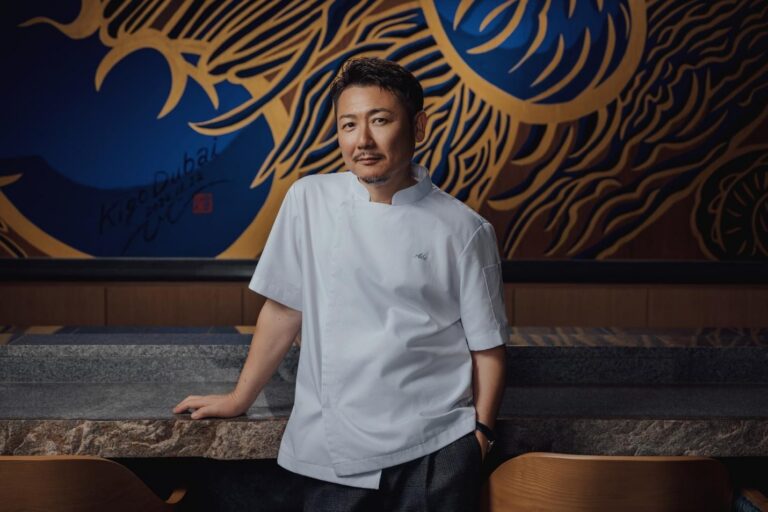



After nearly forty years in the kitchen, Jason Atherton shows no sign of slowing down. “Everyone wants the destination,” he says, “but not everyone wants the journey.” For him, the journey is everything.
During his recent visit to Dubai, he spoke to us about his beginnings, mentors and what continues to drive him.

What inspired you to become a chef?
When my parents split, my mum moved us to a small seaside town called Skegness, where we opened a six-bedroom bed-and-breakfast. We couldn’t afford staff, so my sister and I did everything, serving guests, washing up and cooking breakfast before school. I loved it. I loved the recognition from people when you served them something they enjoyed. By the time I was 13, I told my mum I wanted to be a chef.
At 16, I left school, moved to London, lived in a youth hostel and got a job washing dishes. I didn’t have the skills, but I knew I’d get there if I worked hard enough.
What was it like working your way up in those early years?
Hard. But I’ve always believed hard work beats talent every time. I’ve seen so many talented people never make it because they were lazy or gave up too soon. I didn’t want to go back to the tough life I had as a kid, so I worked incredibly hard. I was the first to arrive, before everyone else, left after everyone else, polished the copper pans and treated every shift like it was the most important. Even now, at 54, I’m still working just as hard. It’s all I know.
Who were your biggest mentors?
I’ve been lucky to work with some incredible chefs. Gordon Ramsay for twelve years, Marco Pierre White for three, Pierre Koffmann and Nico Ladenis, all Michelin-starred chefs. They all taught me different things.
From Gordon, I learned about attention to detail, not just in food, but in everything. He’d walk into a restaurant and immediately know the lighting was wrong or the music was too loud. Marco was great with the media and in creating momentum around his work. And Nico and Diana Ladenis showed me what true perfection looked like, everything in their restaurant was immaculate.

When did you decide it was time to go out on your own?
I was running Maze for Gordon, and we had a Michelin star. But I kept asking myself, if you took Gordon’s name away, was I good enough on my own? I didn’t want to get to 50 and wonder what if?
So I left and started The Social Company with my wife.. We had a young daughter and a good life, so taking that risk was significant. But I needed to know if I could fill a restaurant under my own name. We opened Pollen Street Social in 2011, and it got a Michelin star in six months.
It was never about money or the accolades. I’ve never chased that. I’ve always chased being better at my job. Everything else follows when you’re good at what you do.
How do you define success now?
Everyone measures success differently. For me, it’s simple, your restaurant has to work. You can have every award in the world, but if your restaurant isn’t successful, you haven’t won. When both come together, the recognition and the business, that’s when you’ve really done it.
How do you keep consistency across your restaurants around the world?
Ego kills creativity. You have to listen. If guests don’t like a dish, you change it. It’s not about being precious, it’s about reading your guests.
We also stick to seasons. It’s pointless to buy strawberries from Peru all year round when they don’t taste great. We buy them from Japan in spring or from the UK in summer when they’re at their best. That’s what keeps the the momentum alive.

How has your leadership style changed?
It’s evolved a lot. In my thirties, I was tough because I wanted everything to be perfect. Now, I see myself more as a mentor. But I still expect standards. Even something as small as a wobbly table gets fixed. Because if a drink spills and ruins someone’s evening, that’s on us. The little smallest matter when it comes to creating a great dining experience.
You’ve spoken about purpose and legacy. What does that mean to you?
No one walks through a graveyard saying, that was the richest man in Romania in 1940. People remember what you did, not what you had. That’s what legacy is, what you gave back.
If you’re great at what you do, it naturally brings about respect and recognition. For me, it’s about leaving something that lasts, being remembered as someone who did his job properly.
You’ve published multiple cookbooks. How has that process been compared to being in the kitchen?
Writing a cookbook is like having a baby. The idea is exciting at first, but halfway through, you realise it’s a lot of hard work, testing recipes, researching, rewriting. But when it’s finally out, it’s gratifying. And then you forget how hard it was and you want to do it all over again.
Is there such a thing as work-life balance for chefs?
No, not really. Being a chef at this level is a vocation. You can’t dip in and out of it. Even on holiday, I’m taking notes. If I see a beautiful light fitting or a knife, I’ll log it for future projects.
What advice would you give young chefs starting out today?
Be a chef because you love food. Not for the money, not for fame, not for TV. It’s a long road, and if you’re outstanding, everything else will come to you. Learn every part of the kitchen, how to make bread, prepare sauces, butchery, everything. Don’t rush the process. Too many people today want to have their own restaurant or TV show within six months. It doesn’t work like that.
Plan your career properly. If you do and you stay patient, you’ll have a career that’s truly rewarding.
You’ve had a long relationship with Dubai. How does it feel to come back?
I first came to Dubai in 2000 to open Verre with Gordon Ramsay, the city’s first fine-dining restaurant. Coming back 25 years later and still being welcomed is special. I feel just as much a part of Dubai’s dining story as I do London’s.
My wife and I lived here for five years, we got married here and we still come back every couple of months. Dubai’s food scene has grown so much, it’s incredible to see chefs like Mohamed Orfali and Claudia Peralta shaping it.