
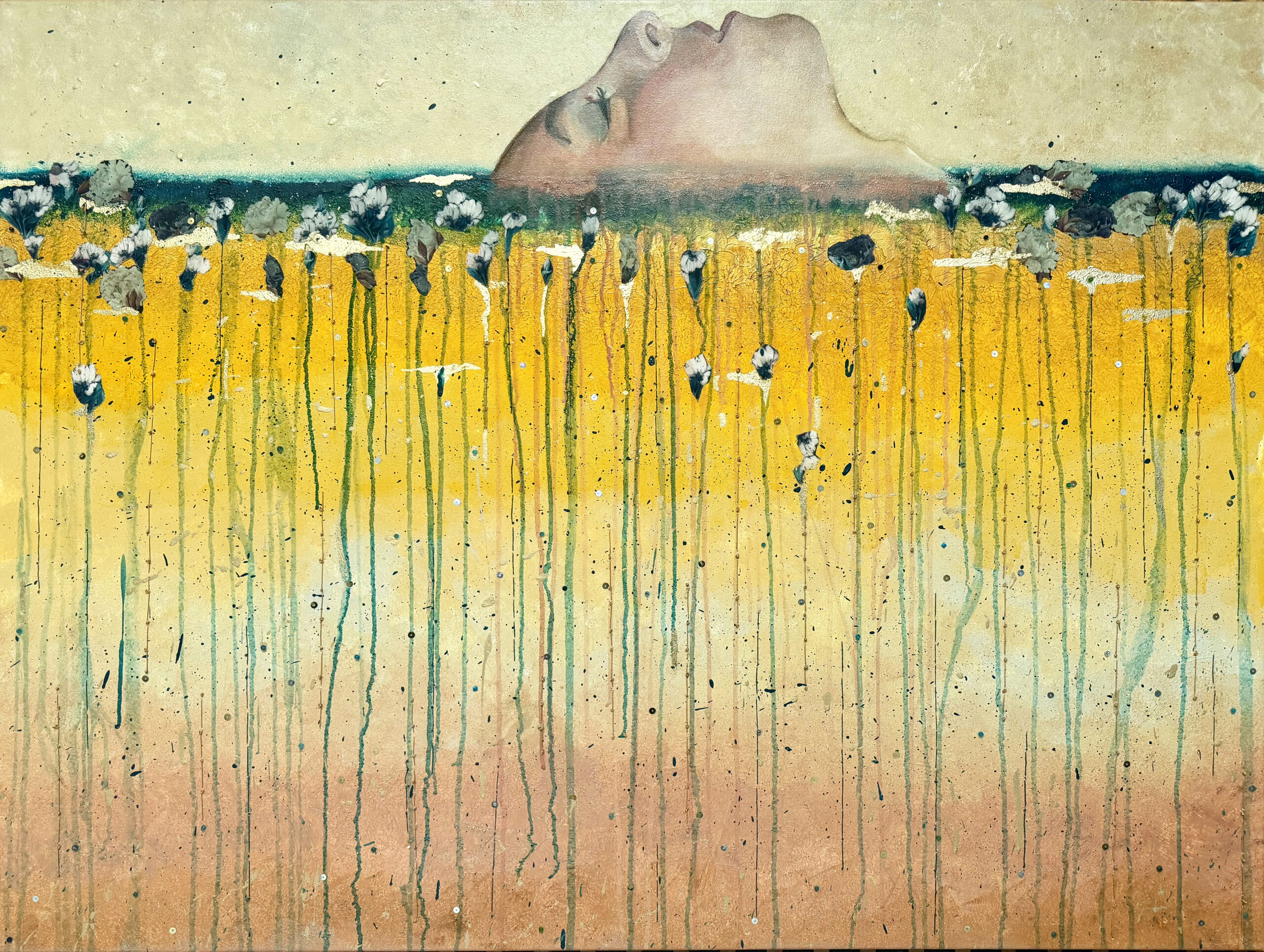

Based in Dubai artist Ghia Haddad’s mixed-media practice brings together painting, embroidery, textiles, beading, and archival research to explore themes of identity and displacement. Her work draws heavily from fibre traditions, particularly Tatreez, while questioning the systems that historically sidelined these forms from contemporary art discourse.
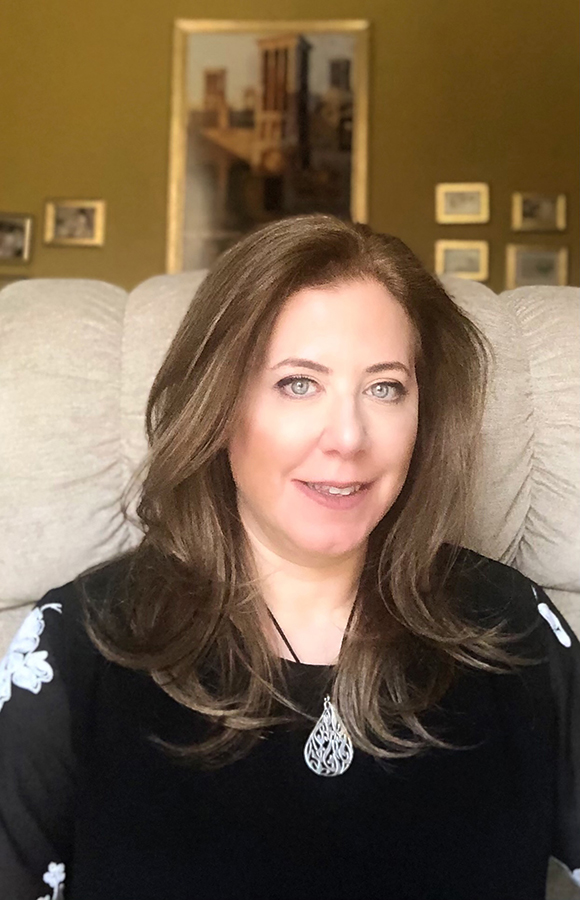
Along with her studio practice, Ghia’s research focuses on museum studies, cultural heritage, and decolonial narratives, creating a body of work that is deeply tied to both personal history and wider social conversations. We spoke to the multidisciplinary artist about reclaiming craft, the politics of visibility, and the role art can play in building cultural dialogue.
Your work moves between fineart, textiles, embroidery, writing, and research. How do these different disciplines inform one another in your creative process?
For me, these disciplines are not separate practices. They are all part of the same language.
My work often begins through research and writing. I spend a great deal of time thinking about material culture, displacement, identity, and the histories that shape how certain people and practices are seen, misunderstood, or overlooked. But those ideas do not remain theoretical. They move into the studio with me.
I am especially interested in the ways memory is carried through materials, rituals, gestures, and domestic practices. Embroidery, textiles, henna, coffee, fabric, even the act of stitching itself all hold forms of cultural continuity that survive despite displacement or erasure. Those ideas shape both my research and my visual practice.
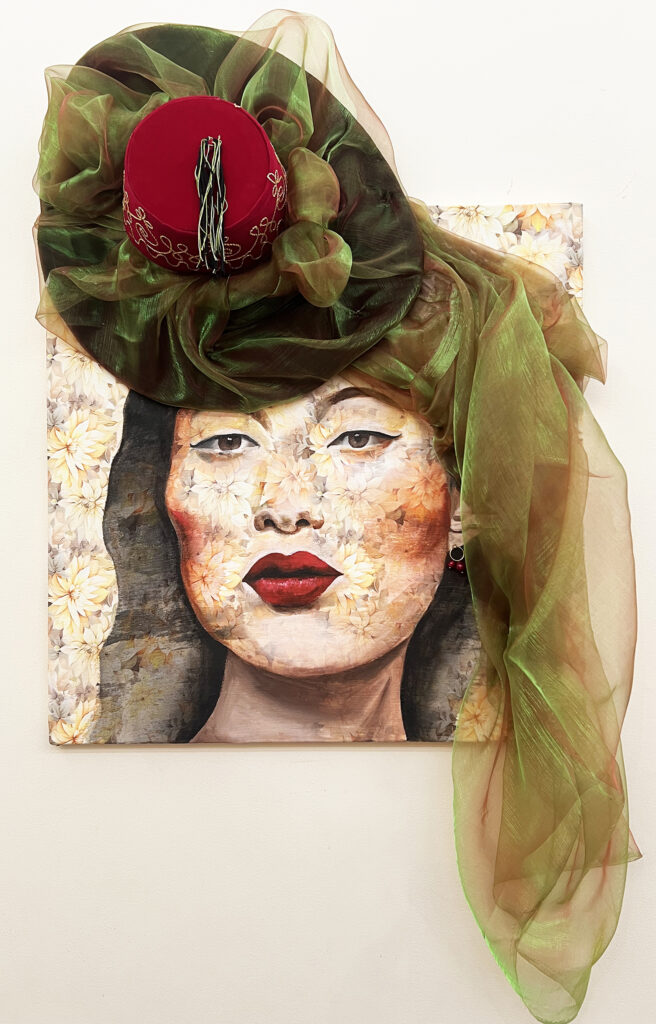
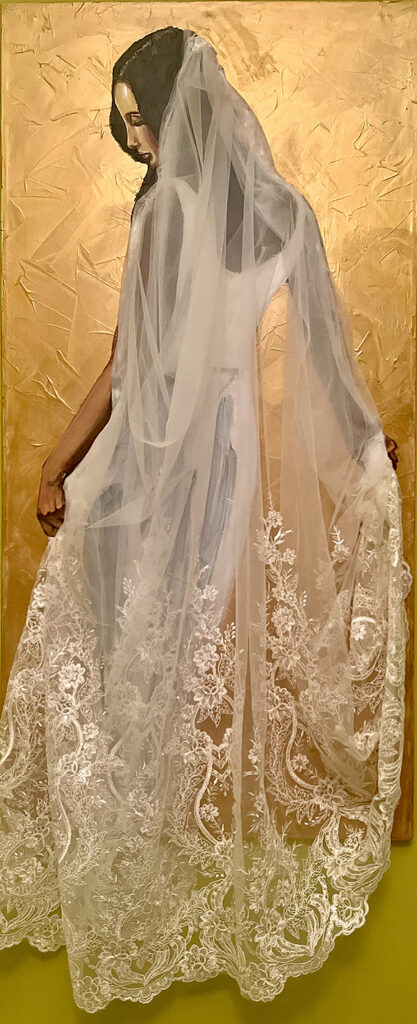
Textiles and embroidery became essential to my work because they carry memory differently than paint alone. Thread records time, labour, repetition, and care. It has a direct relationship to the body and to lived experience. By bringing embroidery, fabric, beads, and fibre into painting, I am also questioning long-standing hierarchies between fine art and craft, and the ways women’s labour and cultural practices have historically been undervalued.
At the same time, making things by hand keeps me connected to the emotional and sensory dimensions of material culture, not only its academic framework. It reminds me that art and culture here are not simply observed. They are lived with, touched, worn, inherited, carried, and remembered.
Writing also plays an important role in helping me understand what the visual work is searching for. Sometimes a painting reveals something I only fully understand later through language or research. Other times, research opens a conceptual door that the artwork then expands emotionally and materially.
In the end, all of these disciplines feed one another through a shared concern with memory, belonging, visibility, and the stories materials are capable of carrying across time.
Are there particular personal experiences or memories that continue to shape your work?
Much of my work emerges from living between places, cultures, and systems of understanding. As an Arab woman who has lived and worked across artistic and academic spaces in different parts of the world, I have become very aware of the tension between cultural experience and the frameworks used to interpret it.
Questions of identity and belonging are therefore not abstract themes for me. They are lived realities. They shape the way I move through the world, the way I understand visibility, and the way I think about my culture within the Western structures that still largely shape how art is exhibited, discussed, and valued globally. Even this interview is taking place in English, a language that at times feels unable to fully hold the more intuitive and nuanced dimensions of my culture.
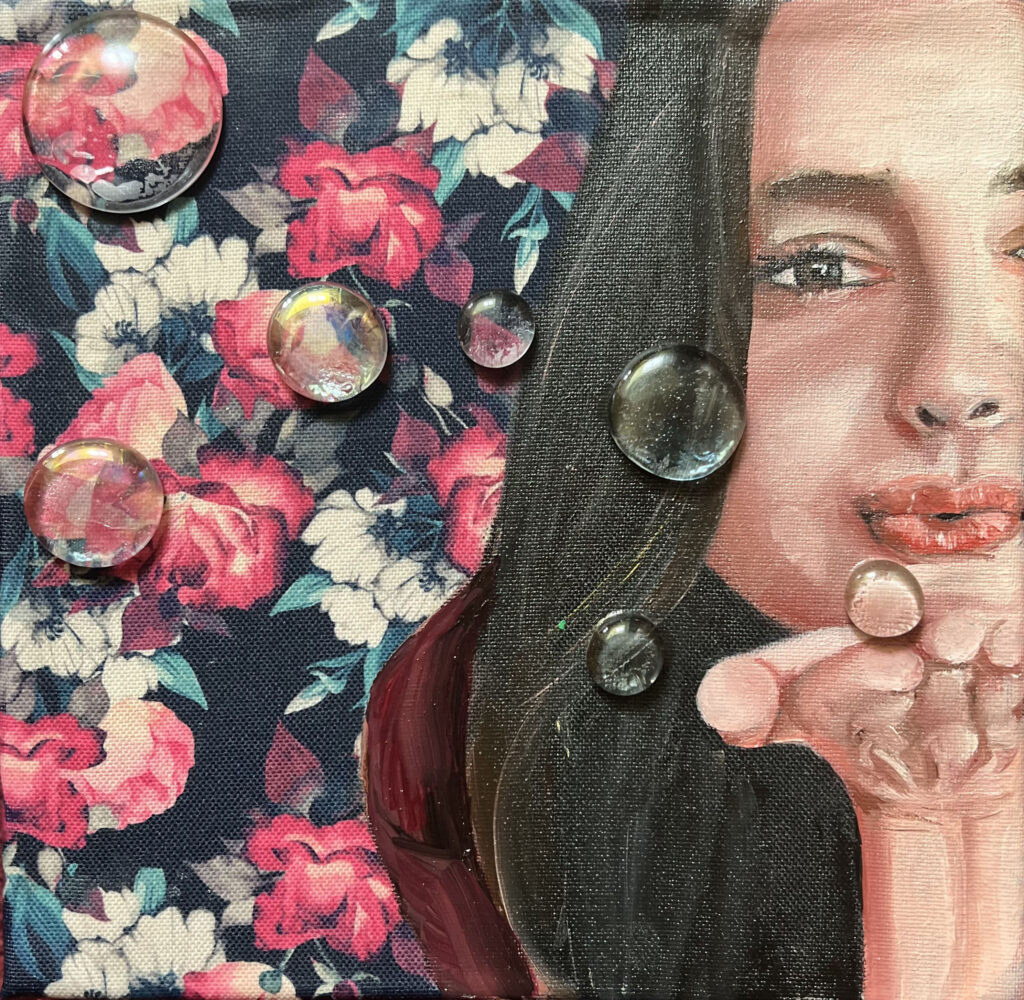
Part of my response to that has been through material itself. I increasingly use mediums not simply as tools for making images, but as part of the message. Embroidery, textiles, beads, fibre, gold leaf, and tactile surfaces allow me to communicate the parts of the story that often remain absent or flattened within dominant cultural narratives. These materials carry memory, labour, ritual, domesticity, and lived experience in ways that traditional painting alone sometimes cannot.
Many of my recent works are also shaped by the emotional condition of living through difficult and uncertain times. The latest Fields series, for example, became a way of thinking through grief, survival, hope, solitude, and self-healing within an increasingly turbulent world. I think art can become a space where we process what feels overwhelming around us while still insisting on beauty, humanity, and endurance.
At its core, my work is often searching for ways to hold onto presence. To leave traces behind. To say: I was here. I felt this. I carried this forward.
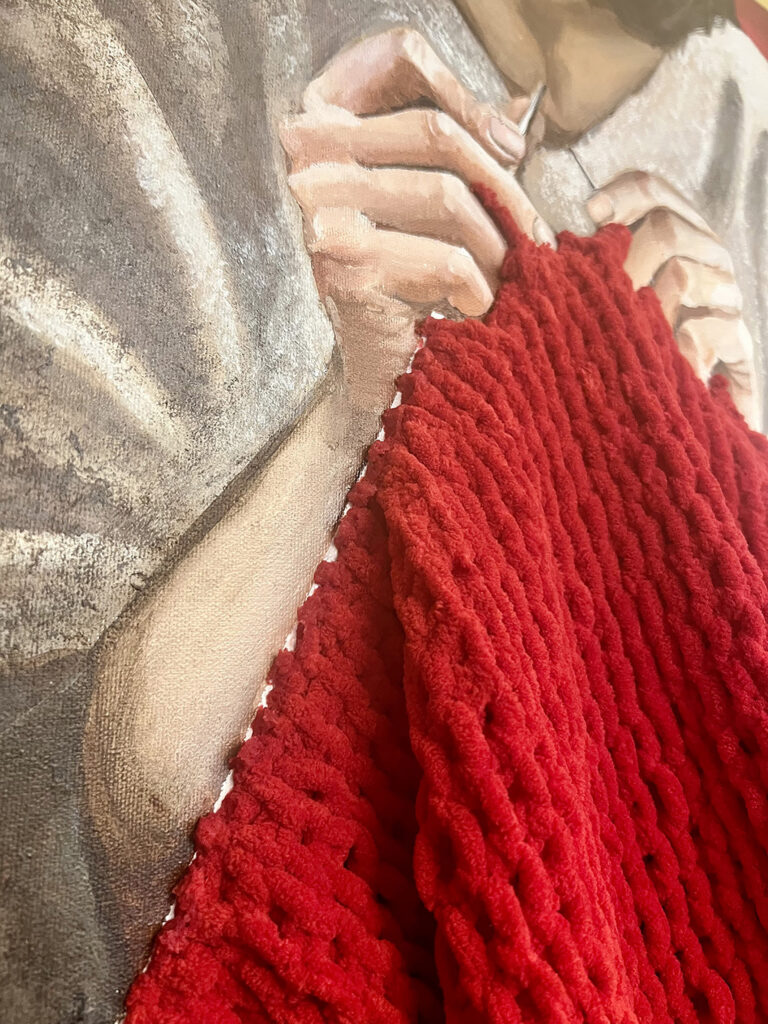
Fibre arts and embroidery have historically been dismissed within traditional Western art hierarchies. What drew you toward reclaiming these mediums within a contemporary art context?
As an Arab woman navigating a world that has historically either erased us or rendered us through colonial and racist lenses, I was drawn to fiber arts and embroidery precisely because of the tension surrounding them. These are mediums historically associated with women, domesticity, labour, and craft, and for that reason they were often pushed outside what Western institutions defined as “high art.” That hierarchy interested me because it revealed how cultural value itself is constructed, and how certain histories, voices, and forms of labor are legitimised while others are diminished.
What I find powerful about textiles and embroidery is that they carry intimacy and resistance simultaneously. Thread can be soft, tactile, and deeply personal, while also holding history, survival, identity, and political meaning. A stitch becomes a mark of presence. Repeated across generations, it becomes continuity.
In my own work, bringing embroidery, fabric, beads, lace, and fibre into painting is not simply an aesthetic decision. It is a way of collapsing inherited divisions between art and craft, between the decorative and the intellectual, between what is preserved and what is overlooked.
Tatreez (Palestinian Embroidery) in particular became important to me because it operates simultaneously as material practice, visual language, memory, and cultural record. It carries stories of geography, movement, community, and displacement within its structure, transforming embroidery from ornamentation into archive. What is especially compelling is that Tatreez has increasingly entered Western museums and galleries not because it was granted legitimacy from outside, but because of the inherent power of the practice itself. Its visual sophistication, emotional depth, and cultural resonance have made it difficult to ignore.
At the same time, Tatreez unsettles long-standing misconceptions surrounding Arab and Palestinian women, who have too often been flattened into simplified narratives that deny complexity, authorship, and agency. Instead, these works reveal generations of women as cultural authors and knowledge keepers preserving identity and meaning through material practice.
I also think fibre has a unique relationship to the body. Unlike many traditional art materials, textiles are touched, worn, repaired, inherited, and lived with. They absorb human presence. Bringing that tactile dimension into contemporary painting allows the work to feel less distant and more embodied.
In many ways, reclaiming these materials is also about reclaiming ways of knowing that have historically been undervalued, not only women’s labor, but forms of cultural expression that exist outside dominant Western art historical frameworks.
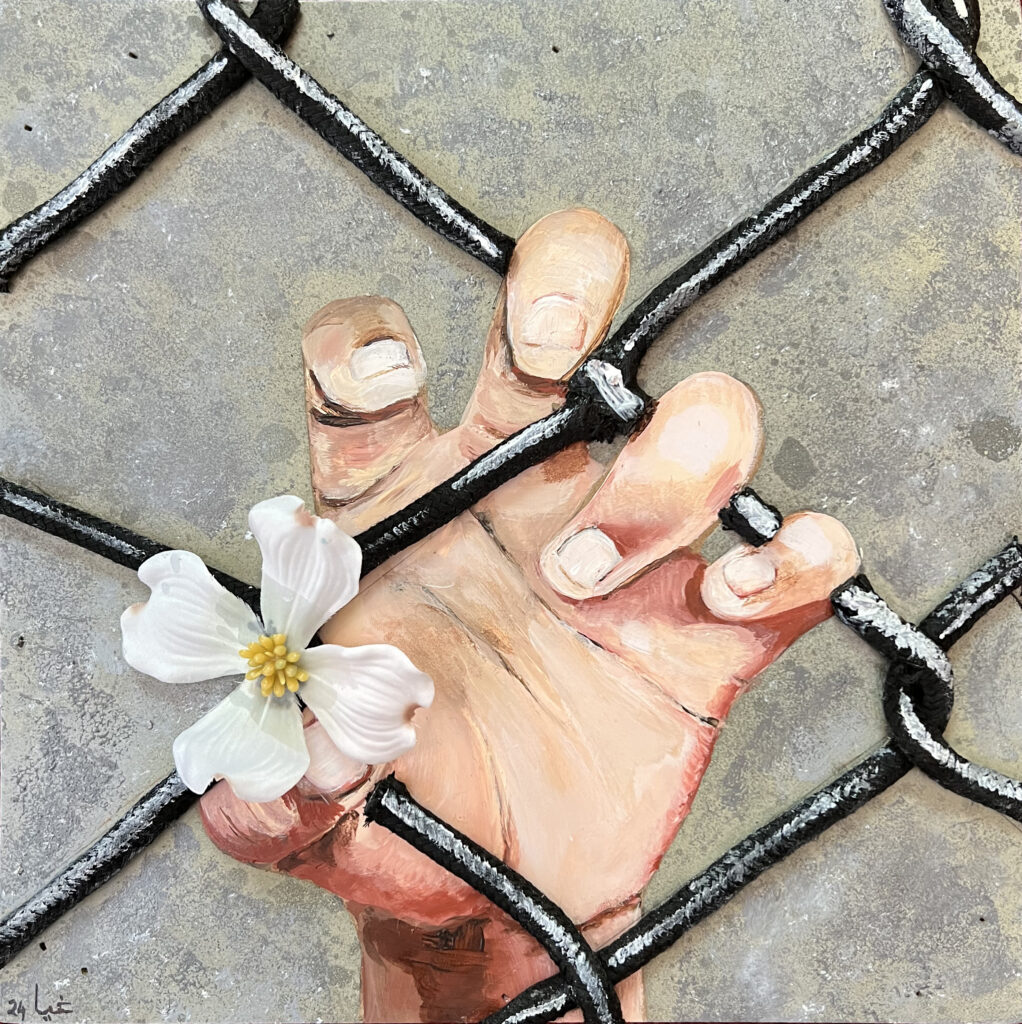
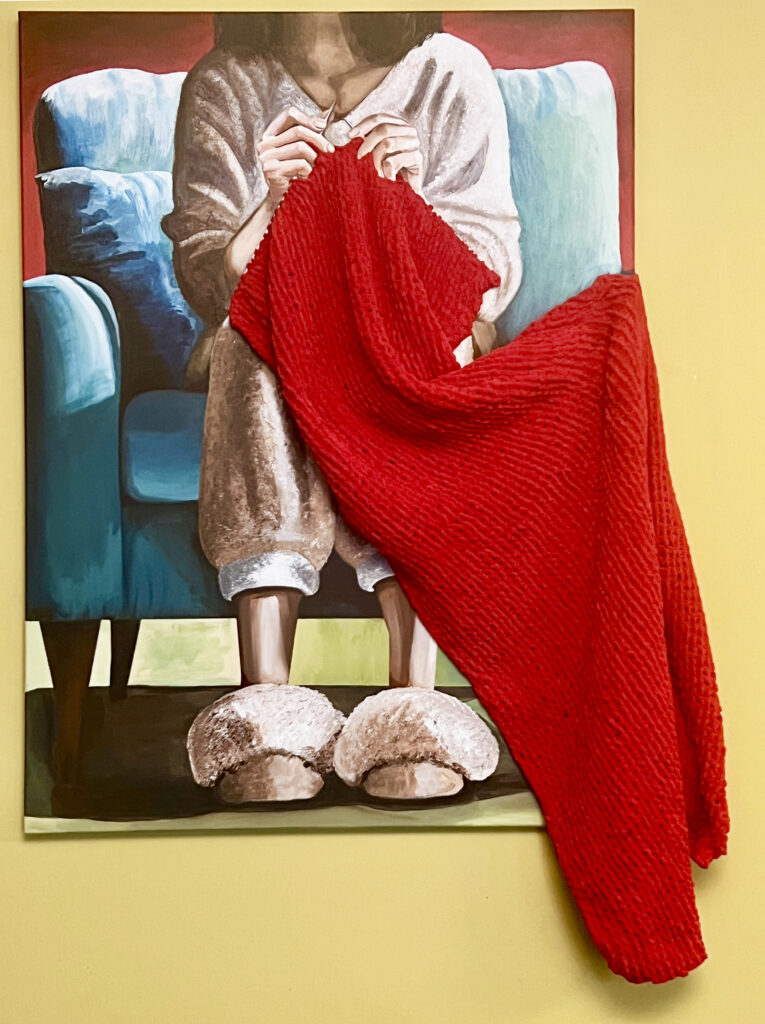
Having lived and worked between Beirut and Dubai, how have both cities influenced your artistic voice and perspective?
Living between Beirut and Dubai has profoundly shaped the way I think about belonging, resilience, and cultural expression.
Beirut gave me an early understanding of complexity. It is a city where beauty, loss, contradiction, history, and endurance coexist visibly and unapologetically. Memory feels alive there, embedded into everyday life, architecture, conversation, food, music, and people. That awareness of fragility, survival, and layered histories continues to shape the emotional undercurrent of my work.
Dubai, on the other hand, shaped my understanding of hybridity, movement, and cultural negotiation. It is a city built through convergence, where languages, traditions, communities, and contemporary realities intersect with grace. What particularly interests me is the unique position of the Emirati population within that landscape. Existing as a demographic minority within their own country creates complex questions around visibility, representation, and cultural continuity within an intensely globalised environment.
Living and belonging in Dubai has heightened my awareness of how cultures, particularly Arab identities, are perceived, translated, simplified, and at times misunderstood. It also made me more conscious of the tension between cultural experience and the frameworks through which it is often interpreted.
Both cities therefore shaped my artistic voice in very different but complementary ways. Beirut gave me emotional depth and historical awareness, while Dubai sharpened my understanding of visibility, representation, and cultural negotiation within contemporary global structures.
I think my work ultimately exists somewhere between the emotional density of Beirut and the evolving landscape of Dubai.
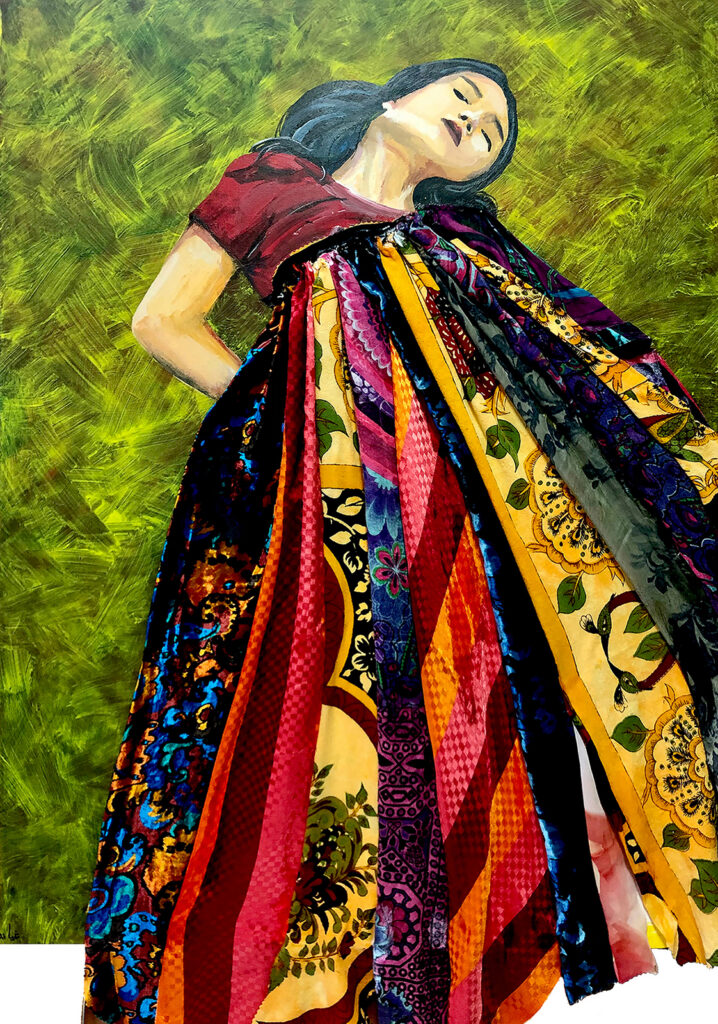
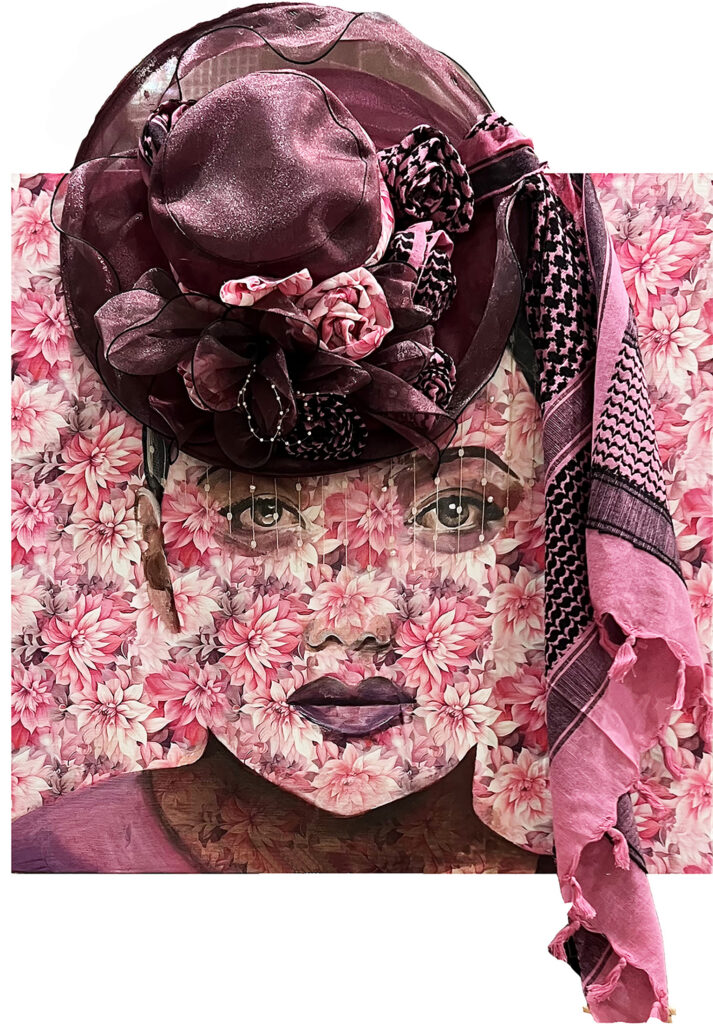
Many of your works invite emotional and even tactile interaction. What kind of response do you hope viewers leave with after experiencing your work?
I hope viewers leave feeling that they have encountered something human and emotionally honest. Not simply something to look at, but something to feel alongside.
Much of my work invites closeness through texture, materiality, and surface. The beads, embroidery thread, fabric, lace, and layered paint are there not only for visual effect, but because they activate memory and sensation differently than a flat image can. Textiles in particular carry an immediate bodily familiarity. We associate them with touch, protection, ritual, labor, inheritance, and presence. I am interested in how material can create emotional access before language even begins.
That tactile dimension is also important to me because it resists the distance that often exists in traditional gallery settings. I want the work to feel lived with rather than untouchable. In many ways, allowing viewers to touch the work begins to unravel some of the elitism that still surrounds the art world, where art can sometimes feel reserved for insiders rather than for everyone.
For me, touch becomes an act of permission. A way of bringing the audience into the work rather than keeping them at a distance from it. It shifts the experience from passive viewing to participation, curiosity, and emotional connection.
Emotionally, I hope people find space inside the work for reflection, recognition, and perhaps even solace. Many of my paintings emerge from questions surrounding identity, displacement, endurance, grief, hope, and self-healing, but I never want the work to dictate a single interpretation. I aim for the viewers to enter it through their own memories and experiences.
Ultimately, I hope people leave feeling more connected. To material, to memory, to one another, and perhaps even to parts of themselves that are often quieted by the speed and noise of contemporary life.
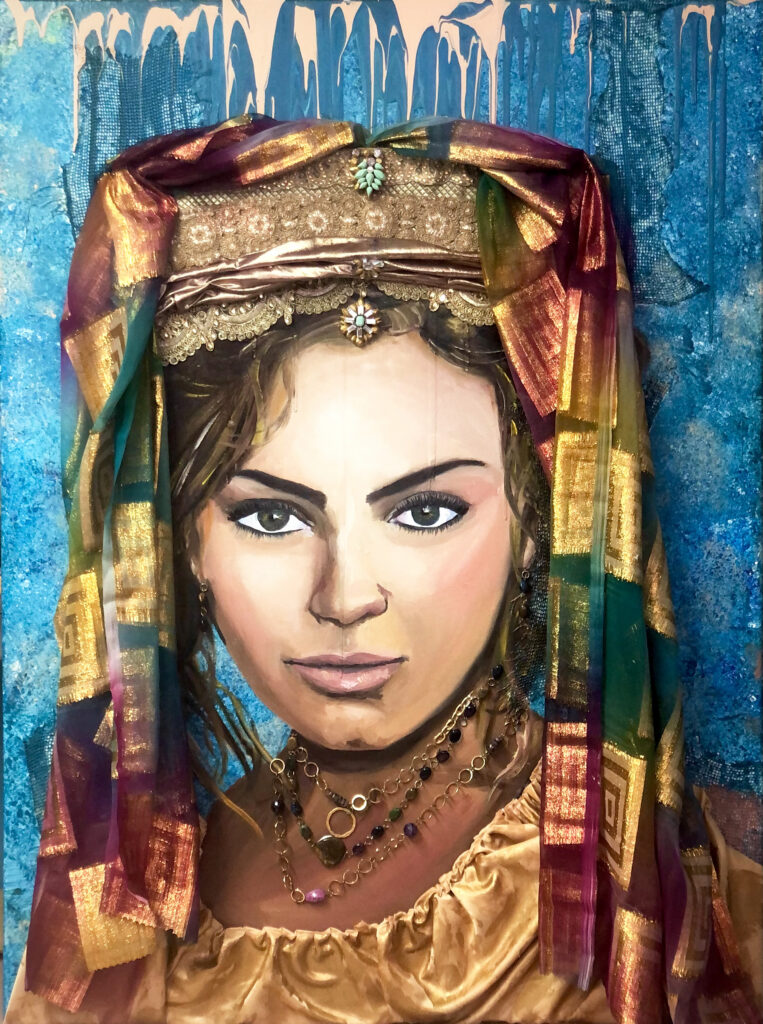
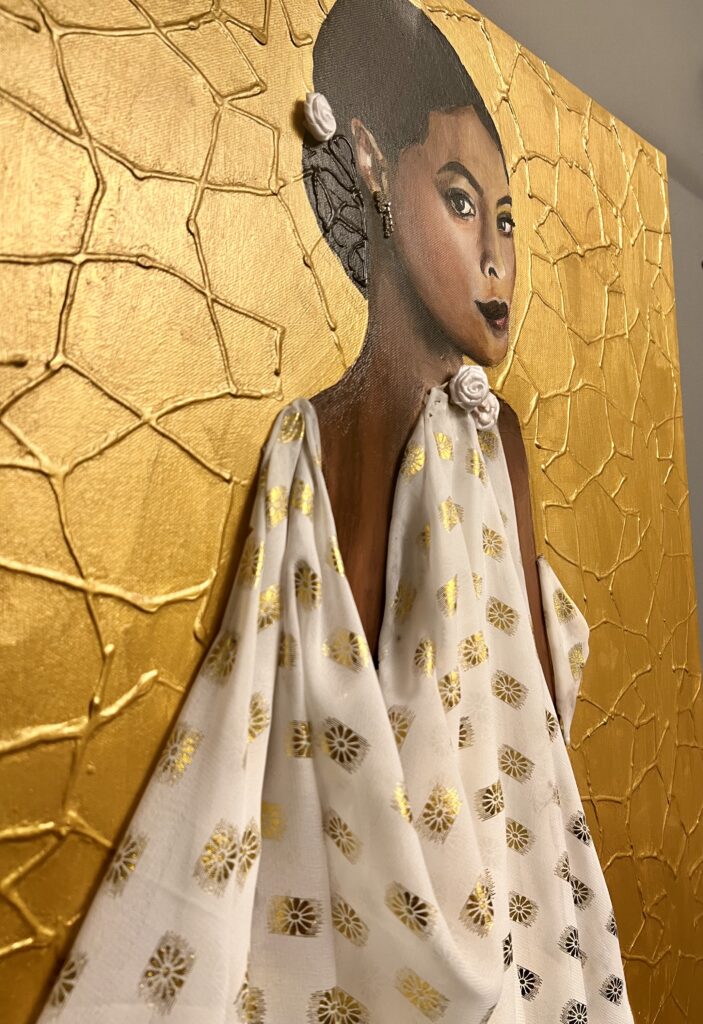
There’s often a strong sense of storytelling in your pieces. Do you approach a work with a narrative already in mind, or does the story emerge through the making process?
I rarely approach a work with a fully formed narrative. For me, the story usually emerges through a collision of memory, research, material, intuition, and inspiration itself.
I think there is sometimes a pressure in the contemporary art world to present artistic practice as entirely original, as though ideas appear in isolation. But art has always built upon itself. Every artist is shaped by the stories that came before them: paintings, literature, music, and performance art. What matters is not denying influence, but transforming it through one’s own emotional and cultural lens.
In my own work, inspiration can come from many places at once. Sometimes from historical research or textiles. Sometimes from poetry, music, political realities, or simply everyday life experiences. These fragments begin to connect through the process of making itself.
Because I work slowly and materially through stitching, layering, attaching, repainting, and rebuilding surfaces, the work has time to evolve. Meanings shift as the piece develops.
I think this is why storytelling in my work is often atmospheric rather than linear. I am less interested in illustrating a fixed narrative than in creating spaces where multiple memories, histories, and interpretations can coexist. The work becomes an accumulation of traces, some personal, some collective, some conscious, some instinctive, but I always hope they remain emotionally accessible.
You’ve worked across graphic design, public art, and studio practice for over three decades. Looking back, how has your relationship with art changed over the years?
Over the past thirty years, my relationship with art has changed from something deeply inward- looking to something much more connected to people, community, and human interaction.
I began in graphic design, where the work was largely about communicating visually for others. It taught me discipline, clarity, and how images function in the world. But at that stage, my relationship with art was also tied to personal success, financial stability, professional growth, and succeeding within existing systems.
That perspective shifted when I moved into public and community art projects after moving to Dubai and starting a family. Through large-scale collaborative projects with schools and communities, I stopped looking primarily inward and started looking outward, toward realities much bigger than myself.
That period was transformative because it revealed something fundamental to me about art. I realized it was a universal language capable of bringing together people who otherwise may never have connected. I watched children and adults from very different backgrounds work side by side, collaborate, and begin to understand one another through the simple act of making something together.
It also made me question the exclusivity that often surrounds the art world. Too often, art is presented in ways that alienate rather than invite people in. Working with communities showed me that the real power of art exists precisely where the most people can access it emotionally and instinctively.
That changed the way I understood my role as an artist. I became less interested in positioning myself at the center of the work and more interested in creating spaces where others could find themselves inside it. In many ways, it was a humbling shift. The less the work became about elevating myself, the more meaningful it became.
Over time, I also began to understand that art can create small but very real forms of change. Through empathy, connection, shared experience, and making people feel seen where they may previously have felt excluded.
Looking back now, I think my relationship with art has become less about object-making and more about connection. About using art not as a symbol of exclusivity, but as a language capable of bringing people toward one another.
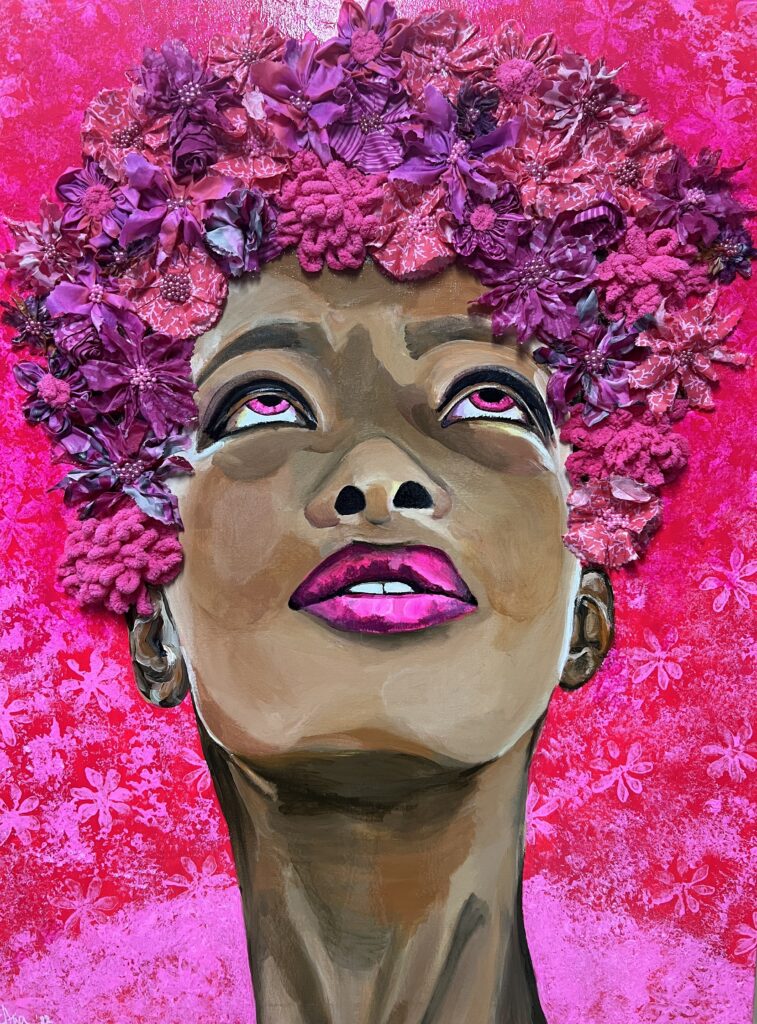
Is there one medium that feels most instinctive or emotionally honest to you?
I do not think there is one medium that feels more emotionally honest to me than another. Over the years, my relationship with mediums has shifted quite dramatically.
I began as a graphic designer, communicating primarily through the printed image; and creating it through drawing, painting, illustration, layout, and visual composition. At that stage, the medium largely served the image. But over time, especially through public and community art projects, the medium itself became part of the meaning and communication of the work.
Working outside the studio pushed me to think less rigidly about what art could physically be. I began experimenting with fiber in public space, recycled materials, collaborative making, performance, costume, and tactile forms of participation. Those experiences completely changed
the way I thought about mediums. I stopped seeing materials as separate disciplines with fixed boundaries.
That shift eventually carried back into my studio practice. Now I rarely begin with the question, “What medium will this be?” Instead, I begin with what I am trying to communicate emotionally or conceptually, and then I search for the material language that can best carry that feeling.
Sometimes paint is enough. Sometimes it is not. Sometimes thread says something a brushstroke cannot. Sometimes beads, fabric, gold leaf, lace, or fiber introduce a tactile and emotional dimension that changes the experience of the work entirely. The interaction between materials becomes part of the communication itself.
So over time, I think my relationship with art has evolved from working within mediums to allowing mediums to remain fluid, porous, and responsive to the needs of each idea. The material is no longer simply a vehicle for the work. It has become an active voice within it.
Are there any artists, writers, or cultural thinkers who have significantly shaped the way you think about art and heritage?
Several artists, writers, and cultural thinkers have profoundly shaped the way I think about art, heritage, representation, and human connection, though each influenced a different facet of my practice. At the same time, I think influence is cumulative and ongoing. The people, cultures, and experiences we encounter throughout life continue to shape the way we see and make work.
Gustav Klimt was an early and foundational influence, particularly in the way he merged portraiture with decorative and graphic elements. His work helped me understand that ornamentation and pattern could carry emotional and conceptual weight rather than exist merely as embellishment.
Henri Matisse also deeply influenced me through his use of collage and cut paper, which helped shift perceptions around glued and assembled materials as legitimate forms of fine art. That openness toward material experimentation stayed with me.
Judy Chicago was extremely important in shaping my thinking around textiles, embroidery, and feminism within art practice. Her work challenged the Western canon by bringing mediums historically associated with women into contemporary art spaces. At the same time, engaging with her work also made me aware of how often feminist art narratives remained centered on Western experiences, leaving many non-Western women outside the conversation. That awareness became important in shaping my own work surrounding Arab women, material culture, and representation.
Edward Said helped me understand and express the Western gaze as Orientalism; the frameworks through which Arabs have historically been viewed and interpreted within Western culture, museums, and art history. His writings helped me recognize how deeply representation is tied to power.
The inspiring StoryCorps initiative reinforced for me the power of personal storytelling and how small human narratives can provoke empathy and meaningful social change more effectively than abstract discourse alone.
Tricia Hersey also influenced my thinking around resistance, particularly the idea that rest, stillness, care, and reclaiming one’s humanity can themselves become forms of dissent.
And finally, the Mural Arts Philadelphia program profoundly shaped my understanding of what community art can achieve socially. Seeing how collaborative public art could create visibility, belonging, healing, and connection helped me understand that art is not simply something to be consumed aesthetically, but something capable of building relationships and promoting good citizenship.
I have also been deeply influenced by the richness of Asian textiles and the way fabric across many Asian cultures functions as its own visual grammar, carrying identity, ritual, status, memory, and storytelling through material itself.
What are you currently researching or experimenting with creatively that excites you?
One of the areas I am currently engaged with is researching the symbolism of the red dress throughout visual and cultural history, and the many ways artists have used it through installation, textile practice, and performance to speak about women, power, beauty, vulnerability, resistance, and social control.
The starting point for this was research I began around The Red Dress Project by Kirstie MacLeod, which eventually developed into an exhibition proposal and research project of my own, with MacLeod’s Red Dress at its epicenter.
What fascinated me was how the red dress repeatedly appears across feminist art and material culture as a powerful visual language carrying layered and often contradictory meanings surrounding visibility, gender, violence, beauty, and identity.
That research is slowly evolving toward a new body of work centered around the red dress concept, exploring how material, scale, tactility, and bodily absence can transform clothing into presence, witness, or protest.
At the same time, my work on Tatreez and material culture continues to evolve. I am increasingly interested in the idea of “counter-curation” as a way of exploring how material culture in Western Asia might be presented outside dominant Western frameworks of making, exhibiting, interpreting, and valuing objects. In many ways, this extends current conversations within Museum Studies surrounding the decolonization of museums, while asking whether entirely different exhibition languages and systems of meaning might also be possible.
Finally, what do you hope people misunderstand less about fibre art and textile-based practices after engaging with your work?
I hope people come away understanding that fibre art and textile-based practices are not secondary to painting or sculpture, nor merely decorative forms existing outside serious artistic discourse. What has historically been dismissed as “women’s work” often carries some of the deepest records of human experience. Textiles are touched, repaired, inherited, worn, and lived with, which gives them a closeness to the body and to everyday life that many materials do not have.
I hope people engaging with my work begin to see textile traditions such as embroidery not as passive ornamentation, but as visual languages and cultural archives that preserve histories and identities across generations, often despite displacement, conflict, or erasure.
At the same time, I hope my work challenges misconceptions surrounding Arab women, who have too often been reduced to simplified narratives. Textile traditions reveal generations of women acting as cultural authors, historians, designers, and knowledge keepers through material practice itself.
And perhaps most importantly, I hope people leave feeling that art should not belong only to institutions, curators, markets, or insiders. Too often, the contemporary art world celebrates the systems surrounding art more than the human impulse that created it in the first place. Art becomes traded, valued, and consumed like a financial asset, distancing it from ordinary people and from the emotional instinct that gave rise to it.
Textile practices remind us of something very different. They remind us that art has always existed within lived human experience, in homes, clothing, rituals, repair, community, and memory. In that sense, I think art should celebrate the audience as much as the artist. It should invite people in rather than intimidate or exclude them. That closeness to humanity is not a limitation of fiber art. It is precisely the strength I wish to highlight in my work.